
Commercial Kitchen Flooring in Hayward
Epoxy Floors Grain Hayward covers commercial kitchen flooring in Hayward — urethane cement, quartz-broadcast epoxy and a coved base — and how a kitchen remodel meets the Alameda County plan check.
Bookings aren't open yet. Leave your name and number; your message is recorded, and you'll get one message when a local installer is available.
 Illustration
What a kitchen floor has to be
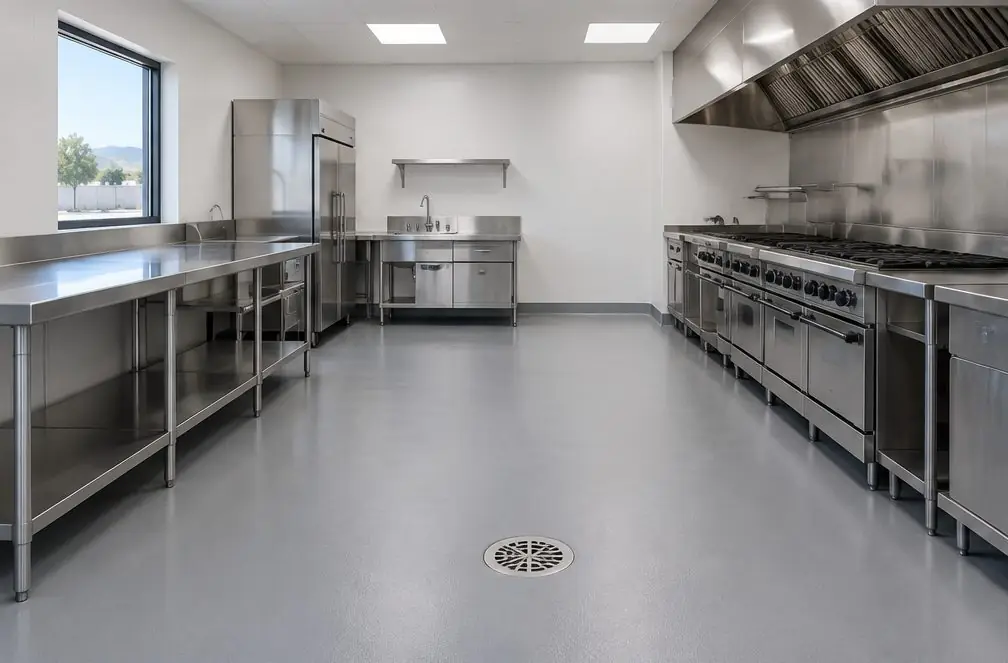
California's food code asks for floors that are smooth, durable, nonabsorbent and easily cleanable, with a coved base where the floor meets the wall. The county environmental health department reviews plans for new or remodeled food facilities and inspects them. In Alameda County the plan-check guide asks for a finish schedule that shows the floor, the cove base, the wall and the ceiling finish of each room, and lists poured epoxy at least a quarter inch thick among the floor types it names, with a specification sheet and a sample.
Why kitchens often use urethane cement
Hot-water washdowns, dropped hot pans and a freezer door a few feet from a fryer make a punishing floor. Urethane cement systems, a thick trowel-applied layer, tolerate heat and thermal shock better than standard epoxy, which is why they are common under cook lines and in dish rooms. Standard or quartz-broadcast epoxy still suits dry prep, storage and front-of-house areas.
| Area | What it faces | Usual choice |
|---|---|---|
| Cook line | Heat, grease, drops | Urethane cement |
| Dish room | Hot water, chemicals, constant wet | Urethane cement with drain slope |
| Prep area | Knife drops, water, foot traffic | Quartz-broadcast epoxy or urethane |
| Walk-in cooler | Cold, moisture, condensation | Cold-rated urethane or epoxy |
| Dry storage | Carts, cardboard | Solid epoxy |
The coved base and the plan check
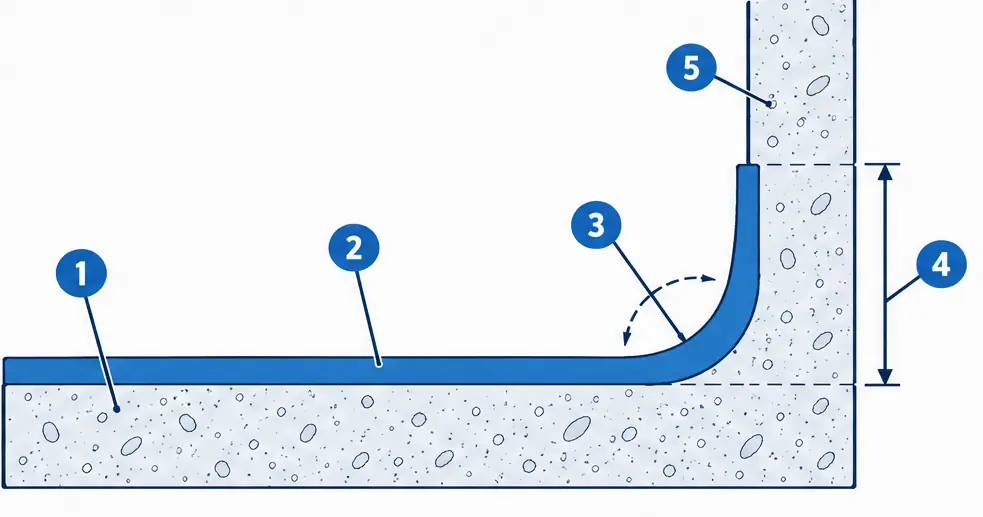
A cove is a curved, seamless transition from floor to wall with a minimum radius of 3/8 inch, and the county guide asks it to run up the wall at least four inches. The guide does not accept top-set rubber or tile base in food prep areas. The first response to a plan submission can take up to 20 working days, or 7 with expedited review, so the floor schedule starts well before the install date.
Drains, floor slopes and grease interceptors are plumbing and building work, separate from the coating.
What the numbers show
- Concrete slab The structural floor, ground and repaired before the system goes on.
- Floor system layer A thick troweled layer, such as urethane cement, that is the wearing surface of the kitchen.
- Curved cove The floor material sweeps up the wall in a smooth radius; the county guide asks a minimum radius of 3/8 inch.
- Cove height The cove runs up the wall at least four inches in food prep areas.
- Wall surface A smooth, nonabsorbent wall finish meets the top of the cove with no gap.
Cure windows for restaurants
Kitchens cannot stay shut for long. Some urethane cement systems take a few days to cure before the kitchen can reopen, and the data sheet sets the exact time. Odor during curing is planned for: ventilation, closed doors to dining areas and a restart date that leaves room for the health inspection of the remodeled space.
Commercial Kitchen Flooring — common questions
Is epoxy approved for commercial kitchens?
No agency approves a floor coating by name. The county reviews the finish schedule and asks for a smooth, durable, nonabsorbent, easily cleanable floor with a coved base, and gives poured epoxy at least a quarter inch thick as one acceptable type.
What does a commercial kitchen floor cost in Hayward?
Urethane cement is typically $12–$20 per square foot, and a 900 sq ft kitchen on a sound slab with a coved base is roughly $12,300–$20,500 with the cove option included.
How long does a kitchen remodel review take?
Alameda County lists up to 20 working days for a first response, or 7 with expedited review. Plans are valid for 6 months.
Commercial Kitchen Flooring: check availability and price range
Bookings aren't open yet — a typical Hayward range in about 30 seconds.