
Garage Floor Prep and Crack Repair in Hayward
Epoxy Floors Grain Hayward covers garage floor preparation and crack repair in Hayward — diamond grinding, crack and spall repair, moisture testing and old-slab checks — the stage that decides whether any coating that follows will hold.

Bookings aren't open yet. Leave your name and number; your message is recorded, and you'll get one message when a local installer is available.
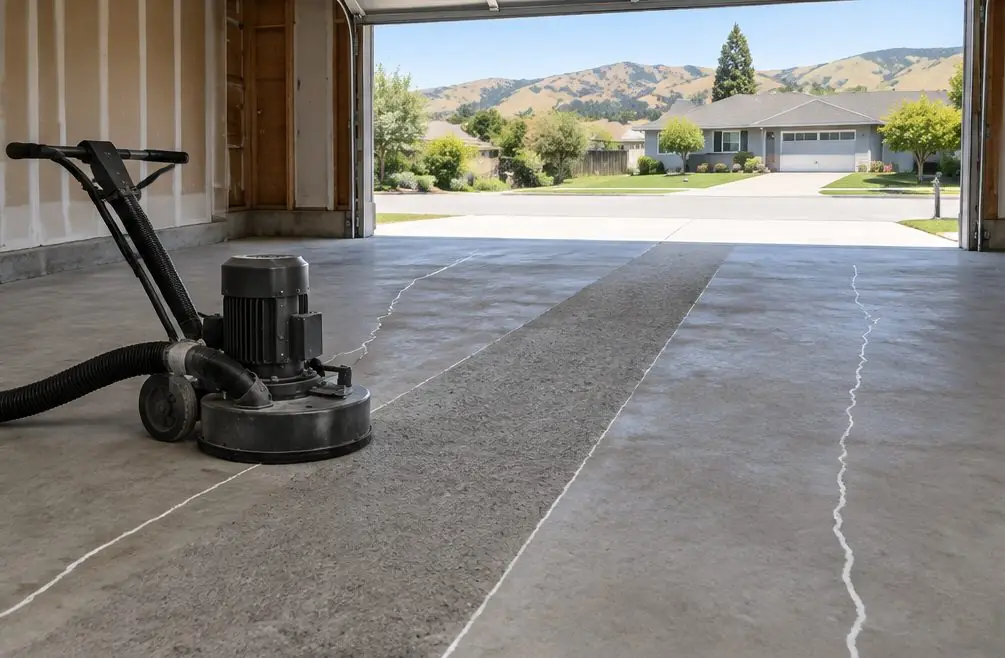 Illustration
Grinding or acid etching
| Diamond grinding | Acid etching | |
|---|---|---|
| How it works | A heavy machine with diamond tooling removes the surface layer | A mild acid is washed on and rinsed off |
| Surface profile | Opens the concrete evenly, measured as a CSP number | Variable; weak on dense or sealed slabs |
| Dust | Controlled with a shroud and vacuum | None, but rinse water must be handled |
| Old sealer or paint | Removed | Does not remove it |
| Used by | Most professional installers | Mainly DIY kits |
Diamond grinding opens the surface so the coating can bond; acid etching is a weaker substitute.
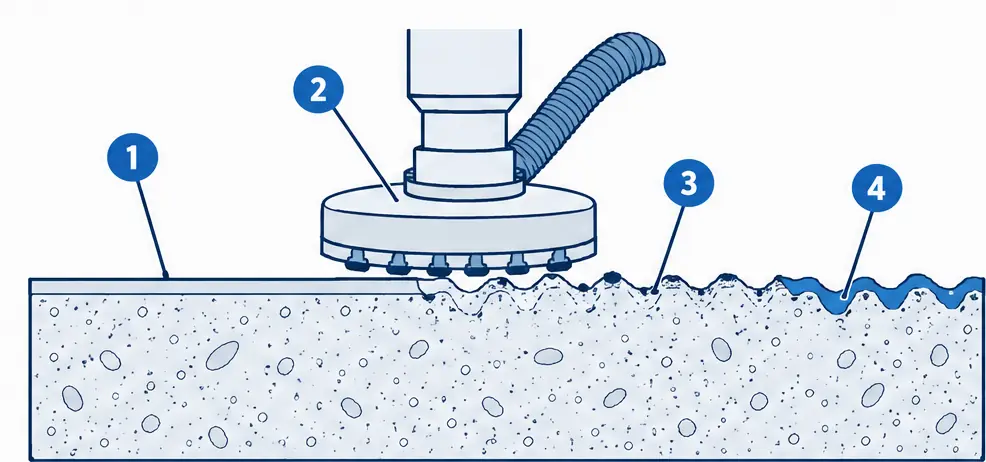
What the numbers show
- Smooth troweled skin The dense, glassy surface a slab gets when it is troweled; a coating can sit on it without gripping.
- Diamond grinding head Tooling set with diamond segments spins across the slab and removes the skin, dust drawn away by a vacuum.
- Ground profile An even field of small peaks and valleys; the profile is measured on the concrete surface profile (CSP) scale.
- Coating keyed into the profile The first coat flows into the valleys and cures, locking mechanically to the concrete.
Testing for moisture before anything goes down
Moisture vapor rising through a slab can push a coating off. Many post-war Hayward garages were poured without a vapor barrier, so testing carries extra weight. Three common tests, from quick to thorough:
| Test | How it works | What it tells you |
|---|---|---|
| Plastic sheet | A taped square of plastic left for a day or two | Moisture under the sheet points to vapor from below; on top, to condensation from the air |
| Calcium chloride (ASTM F1869) | A dish of salt sealed under a dome | The rate of vapor leaving the surface |
| In-slab humidity probe (ASTM F2170) | A probe in a drilled hole | The relative humidity inside the concrete |
Where readings are high, installers use a moisture-mitigating primer or reconsider the job. A damp slab condition adds about $2–$5 per square foot in the estimator.
Fault-zone cracks and the repair that matches
Hayward sits along the Hayward Fault, and a slab that has settled or shifted tells its own story. Cracks fall into groups, and the repair follows from the type.
- Hairline shrinkage cracks are routed, filled and ground flush.
- Joint lines are cleaned and filled with a flexible filler, or left as joints.
- Stepped cracks, where one edge sits higher, are ground or patched.
- Spalls, chipped corners and pits, are filled with a repair mortar.
Repairs are priced as a slab condition (about $1–$2 per square foot for hairline cracks and pitting) or as extra repair work if the cracks are numerous.
Older paint, older mastic
In homes built before 1978, old paint and some garage floor mastics can contain lead or asbestos. A grinder can throw that material into the air, so owners planning to grind a pre-1980 garage floor or remove old coating often have the material tested first. Grinding is done with a dust shroud and a vacuum, and the area is cleaned afterward.
Garage Floor Prep and Crack Repair — common questions
How much does garage floor prep cost?
Basic grinding is part of the coating price. The estimator adds about $1–$2 per square foot for cracks and pitting, $2–$4 for old coating removal and $2–$5 for heavy oil or a damp slab.
Will the crack come back after repair?
A moving crack may show again. Hairline cracks usually stay hidden; stepped or widening cracks are watched, and a foundation or concrete trade is called in when the slab itself is the problem.
Does a moisture test cost extra?
A plastic-sheet check is cheap. Calcium chloride and humidity-probe tests cost more, and the estimator lists a moisture-vapor primer as an option rather than a requirement.
Garage Floor Prep and Crack Repair: check availability and price range
Bookings aren't open yet — a typical Hayward range in about 30 seconds.