
Polyaspartic Garage Floor in Hayward
Epoxy Floors Grain Hayward covers polyaspartic and polyurea garage floors in Hayward — fast-curing coatings over a ground slab, often installed in a single day — with a plain account of how they compare with epoxy.
Bookings aren't open yet. Leave your name and number; your message is recorded, and you'll get one message when a local installer is available.
 Illustration
Why polyaspartic cures so fast
Polyaspartic and polyurea coatings are related chemistries that set in hours rather than days, which is why many systems can be installed in one day. The same speed shortens the working time: the installer has minutes, not an hour, to spread the material, and heat shortens it further. That is also why the preparation matters so much; there is no time to fix a poorly ground patch once the coat is down.
Where polyaspartic is the better pick, and where it is not
| Question | Polyaspartic | Epoxy |
|---|---|---|
| Sun at the open door | Aliphatic types are generally more UV-stable | Can amber in sunlight |
| Time before the floor is used | Foot traffic often the next day | Usually several days before a car |
| Working time on site | Short; needs a practiced crew | Longer; easier to spread |
| Price per sq ft | $8–$13 for a flake system | $5–$10 |
| Odor while curing | Can be strong, ventilation planned | Noticeable, varies by product |
Polyaspartic is not "stronger than epoxy" in any measured way a site like this can promise. It is faster and more UV-stable, and it costs more.
What the numbers show
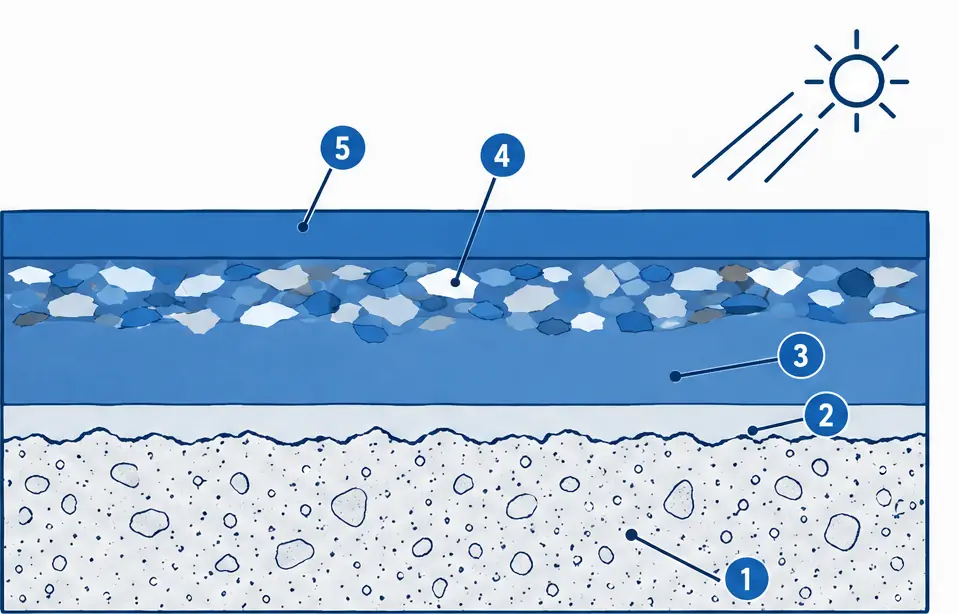
- Ground concrete slab The coating is only as good as its bond, so the slab is ground to an even rough profile first, and its cracks are filled.
- Primer or moisture-mitigating primer Used where a moisture test or the slab calls for it; it sits between the concrete and the base coat.
- Polyaspartic base coat A fast-curing colored layer that holds the flakes; the installer has little working time, so it goes down in measured strips.
- Broadcast flakes Chips thrown into the wet base coat and embedded as in any flake system.
- Polyaspartic topcoat A clear, generally UV-stable layer over the flakes; many systems are installed in a single day.
The cure timeline in practice
| Stage | What happens | Typical timing |
|---|---|---|
| Prep | Grind, repair, vacuum | The first part of the day |
| Base and flake | Rolled and broadcast | A few hours |
| Topcoat | Polyaspartic applied | Same day on a one-day system |
| Foot traffic | Walk on it carefully | Often the next day |
| Vehicles | Drive back in | Per the data sheet, often 24 hours to several days |
Times depend on the product, the temperature and the humidity on the day. They are ranges, never promises; the data sheet for the chosen product governs.
Fumes and the open door
Some systems smell strongly while they cure, and the odor can linger for a while after. The garage door is opened for ventilation, people and pets stay out until the data sheet says otherwise, and an attached house is planned around so the smell does not follow the air into the living space.
Polyaspartic Garage Floor — common questions
Is polyaspartic worth the extra cost in a Hayward garage?
It can be, when the door faces sun, the garage is needed back quickly or the slab will see a lot of use. For a covered, lightly used garage, epoxy with a polyurethane topcoat is often enough.
Can polyaspartic go over a damp slab?
Moisture coming up through the concrete can push any coating off. A moisture test comes first, and a moisture-mitigating primer may be specified where readings are high.
What is the difference between polyaspartic and polyurea?
Polyaspartic is a type of aliphatic polyurea. Both set quickly; polyaspartic coatings are generally more UV-stable and have a slightly longer working time than pure polyurea.
Polyaspartic Garage Floor: check availability and price range
Bookings aren't open yet — a typical Hayward range in about 30 seconds.