
Worked case: a 1,600 sq ft four-bay auto repair shop with oil-soaked concrete near the 92 and 880 interchange — what happens and what it costs
Epoxy Floors Grain Hayward walks through a typical auto shop job near the Highway 92 and I-880 interchange in Southgate: four service bays totaling 1,600 sq ft, concrete stained deep with engine oil and brake fluid, and a solid-color epoxy with grit laid one bay at a time with bay lines painted on top.
Bookings aren't open yet. Leave your name and number; your message is recorded, and you'll get one message when a local installer is available.
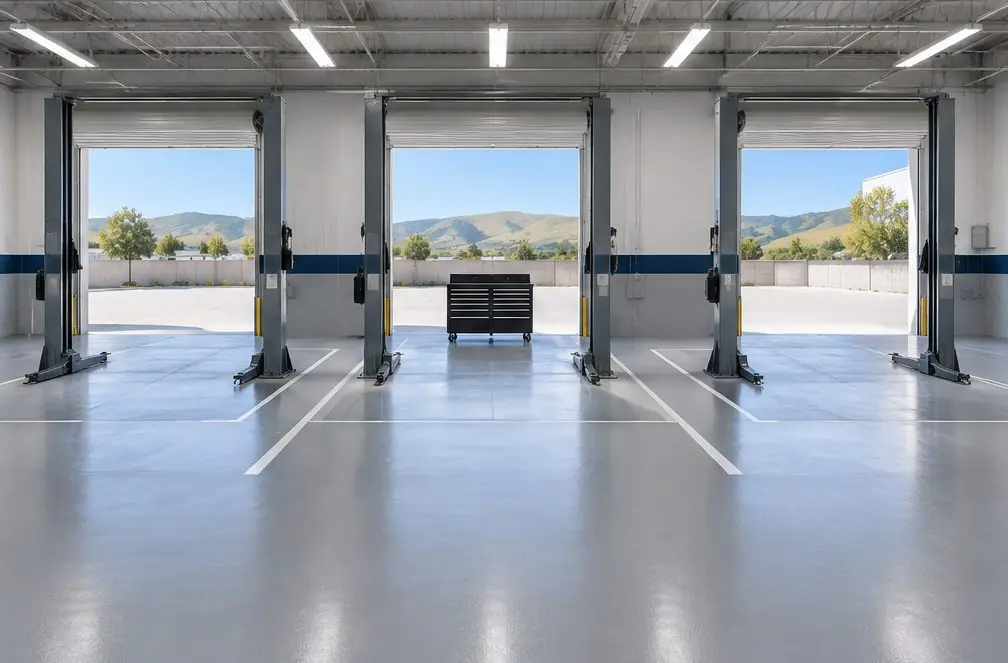
Worked example. The pictures are AI concept illustrations, not photographs; no installation was performed or arranged through this site; prices are typical Hayward area market ranges, not quotes.
 Illustration
Project Examples & Typical Prices
The scenario
Think of an independent repair shop in a small building a few blocks from the freeway interchange. It has four service bays: two with vehicle lifts, one used for alignment and one for general repairs, plus a short front counter where customers wait. The floor in the bays is a patchwork of old gray paint worn through to bare concrete, with dark halos of oil under each lift and a long streak of brake fluid by the alignment rack. Tool cabinets and tire racks sit along the side wall.
The shop earns its money every day, so a shutdown of the whole building is not an option. The real obstacle is the slab itself: concrete that has absorbed years of drips will push oil back out through a new film unless it is cleaned and ground deeply first.
The starting conditions at a glance:
- Area: about 1,600 sq ft over four bays
- Slab: soaked with oil and brake fluid, old paint worn thin
- Equipment: two lifts, an alignment rack, tool cabinets, tire racks
- Business need: one bay out of service at a time, never all four
- Finish wanted: mid-gray with painted bay lines and a walkway
What the job involves
- The installer inspects each bay, marks the darkest stains, and checks how deep the oil goes by wetting the concrete and drilling a small test core in the worst spot.
- The work is scheduled bay by bay; the car, the tools and the lift equipment in the working bay are shifted into the neighboring bays for the day.
- A degreaser is worked into the stained areas and rinsed away with absorbent pads; the bay is then ground deeply with heavy diamond tooling, and the worst halos get a second pass or are cut out and patched.
- A primer and then a solid-color epoxy with grit are rolled on in strips, paying attention to the footprint under each lift.
- A clear fluid-resistant topcoat follows, and the bay cures for the time the data sheet gives while the next bay is prepared.
- After the cure, bay lines and a walkway to the counter are painted, and each bay goes back to work as the data sheet allows, with lifts and jack stands set only on ground, repaired concrete.
Materials and prep
- A heavy diamond grinder with a vacuum extractor, plus a degreaser and absorbent pads
- Patching mortar for spots where the oil has gone too deep to grind away
- Primer and a solid-color epoxy base coat with an anti-skid aggregate
- A fluid-resistant topcoat, checked against the shop's own brake fluid, coolant and cleaners on the data sheet's chemical chart
- Floor-marking paint for bay lines, walkways and tool-cabinet zones
- Fans and temporary barriers so fumes and dust stay out of the customer counter
What it typically costs in the Hayward area
| Solid-color epoxy with grit, 1,600 square feet installed ($5–$9 per sq ft) | $8,000–$14,400 |
| Heavy oil or grease saturation (+$2–$5 per sq ft) | +$3,200–$8,000 |
| Line striping and safety markings | +$300–$900 |
| Typical total | $11,500–$23,300 (market range, not a quote) |
These are typical local ranges, not a quote or an offer; an installer prices the actual job after seeing the floor.
Add-ons often paired with this job
- Line striping and safety markings — +$300–$900. Painted bay lines and a customer walkway give staff and visitors a clear traffic plan.
- Control-joint filling with a semi-rigid filler — +$400–$1,200. Joints inside a bay are refilled so jack wheels and creepers do not chip the edge.
- Coved base along about 100 linear feet of wall — +$1,500–$2,500. Some shops add a coved base in the customer lobby.
Why it is done this way
Solid epoxy with grit is the standard repair-bay floor because it stands up to the common automotive fluids and gives boots and creepers something to hold. The chemical-resistance chart in the product data sheet is read against brake fluid, coolant and solvents, with exposure times, before the topcoat is chosen.
The oil is the line in the budget that matters. Soaked concrete adds $2–$5 per square foot to a clean-slab price, and a patch of badly soaked concrete may have to be cut out and replaced by a concrete trade before anything is coated.
Hot-tire pickup, where a warm tire lifts the film, is mostly a preparation and product problem. Deep grinding and a system rated for the use matter more than the color.
The alternatives that were weighed and set aside:
- Flake epoxy at $6–$11 per square foot hides stains well and costs more across four bays.
- A clear sealer on bare concrete is cheaper and wears off fast under tires and creepers.
What would change the price
- A lift pit or floor drain needs its own detail.
- Oil turns out to run deeper than grinding reaches, so the spot is cut out and patched.
- The shop can free only one bay for a day at a time, which stretches the project over more weeks.
- An unusual fluid needs its own chemical-resistance check.
- The landlord's written consent is needed before work starts.
Where this leads
- Service page: Auto Shop Floor Coating — Floor coatings for repair bays, detail shops and workshops, built for oil, brake fluid and jack stands.
- Local page: Epoxy garage floor in Southgate
- All services and typical prices: epoxy garage floor in Hayward
- More worked examples: Project Examples & Typical Prices
Check availability and the price range for this setup
Bookings aren't open yet — a typical Hayward range in about 30 seconds.