
Worked case: a 420 sq ft two-car garage with full-broadcast flake in Mission-Garin — what happens and what it costs
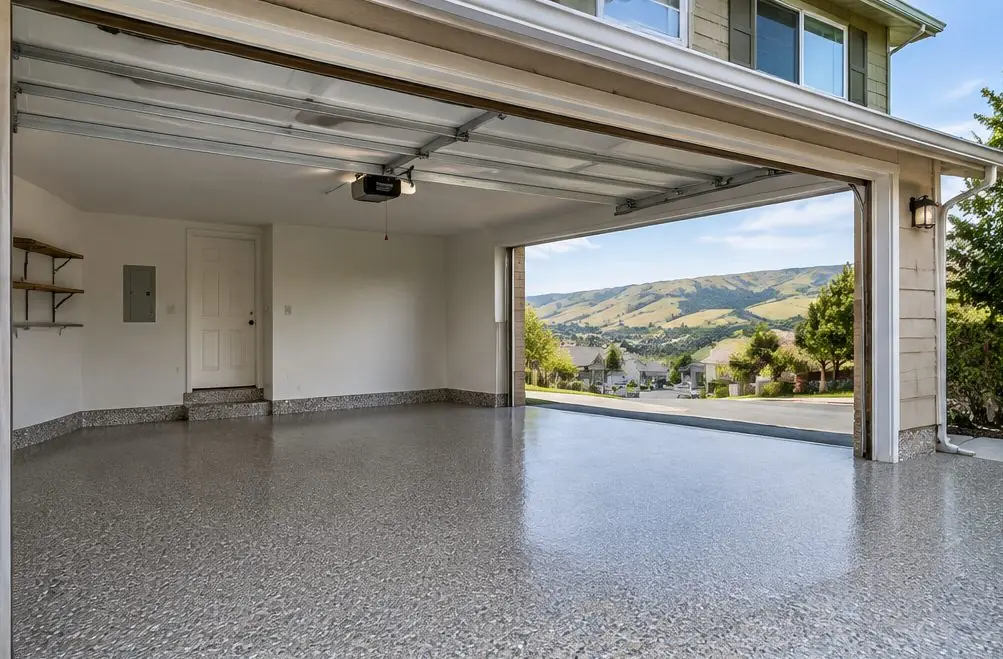
Epoxy Floors Grain Hayward walks through a typical flake epoxy job in a Mission-Garin home built in the 1990s or early 2000s: a 420 sq ft two-car garage whose slab is sound and a little dull, a full-broadcast gray-and-tan flake floor, a coated garage-door curb and a custom flake blend.
Bookings aren't open yet. Leave your name and number; your message is recorded, and you'll get one message when a local installer is available.
Worked example. The pictures are AI concept illustrations, not photographs; no installation was performed or arranged through this site; prices are typical Hayward area market ranges, not quotes.
 Illustration
Project Examples & Typical Prices
The scenario
Picture a two-story home in one of the Mission-Garin streets south of Mission-Foothill, built in the era when subdivisions of single-family houses spread across these hills. The garage is a standard two-car, about 20 by 21 feet, with a smooth steel-troweled slab that has never been coated. There are a few oil drips where a car sat, a handful of hairline lines at the control joints and no visible cracks across the floor. The owner wants a floor that hides tire dirt, looks finished and sweeps clean.
The slab is newer than most in Hayward, and builders of that period commonly put a vapor barrier under the slab, but a reading on the day is the only proof. The brief is a full-broadcast flake epoxy floor in a mixed gray and tan, with the curb at the garage door coated so water stops at a clean edge.
The starting conditions at a glance:
- Area: about 420 sq ft, two-car
- Slab: newer, sound, hard-troweled surface, hairline joint lines only
- Stains: a few oil drips from parked cars
- Door: a low concrete curb at the garage door to be coated
- Look: mixed gray and tan flake, a custom blend of the owner's choosing
What the job involves
- The installer measures the floor and the curb, notes the oil drips and checks the slab with a plastic-sheet moisture test, a taped square left in place for a day or two, to see whether moisture is rising from below.
- A diamond grinder with a dust shroud and vacuum opens the entire surface and the edges, leaving a rough, even profile; a hand grinder reaches the corners and the curb.
- Joint lines are cleaned and filled with a flexible joint filler, oil spots are degreased and ground a second time, and the floor is vacuumed until no dust remains.
- A pigmented epoxy base coat is mixed in measured batches and rolled out in strips; while it is still wet, the flake blend is thrown by hand until the surface is covered completely.
- Once the base has set, the loose flake is scraped and swept away and the floor is vacuumed; a clear topcoat is rolled on to bury the flake and leave a smooth finish, with fine grit added for grip.
- The curb is coated at the same visit, the topcoat cures for the time the product's data sheet gives, and the owner is told when feet and, later, the car can go back on the floor.
Materials and prep
- Diamond grinder with a dust shroud, a hand grinder for edges and a HEPA-style vacuum
- Pigmented epoxy base coat, 100%-solids or water-based per the installer's choice, measured and mixed by batch
- Full-broadcast flake in a custom gray and tan blend, a few pounds per hundred square feet
- Clear topcoat (epoxy or polyurethane) with a fine anti-skid additive
- Joint filler, degreaser, rollers, squeegees and spiked shoes for walking in wet coating
- Plastic sheeting and tape for the moisture test, masking for the door seal and garage walls
What it typically costs in the Hayward area
| Flake (chip) epoxy, full broadcast, 420 square feet installed ($6–$10 per sq ft) | $2,520–$4,200 |
| Coat the stem wall or garage-door curb | +$150–$350 |
| Custom flake blend | +$60–$180 |
| Typical total | $2,730–$4,730 (market range, not a quote) |
These are typical local ranges, not a quote or an offer; an installer prices the actual job after seeing the floor.
Add-ons often paired with this job
- Coat the stem wall or garage-door curb — +$150–$350. The curb at the door takes an hour of hand work and a few pounds of material and gives the floor a finished edge.
- Custom flake blend — +$60–$180. A custom blend of gray, tan and black chips costs a little more than a stock mix and reads as one of a kind.
- Move and return garage contents — +$100–$300. If the garage is full, moving and returning shelves and boxes is a separate flat line.
Why it is done this way
Full broadcast is the right call on this floor because the slab is clean and the owner wants a uniform surface. Where flake covers every inch, the base color never shows through, which is why this style hides oil drips and tire marks better than a partial broadcast or a plain color.
Grinding the new slab matters as much as on an old one. A hard-troweled skin is smooth and dense, and a coating can fail to grip it; the grinder opens it. A moisture test costs little compared with redoing a floor that peels at the door.
The alternatives that were weighed and set aside:
- Polyaspartic flake would cost $8–$13 per square foot instead of $6–$10 and suits a garage that must return to service sooner; the owner has no deadline.
- A solid-color epoxy is cheaper but shows tire marks and does not hide the oil spots as well as flake.
What would change the price
- The moisture test reads high — a moisture-mitigating primer is added, and the timeline stretches while the slab is checked again.
- A garage-door seal or step needs repair before the curb can be coated.
- Fine cracks turn out to be wider along the center — the repair becomes an extra line.
- The owner picks a heavier textured topcoat, which grips more and takes more scrubbing.
- Tight cure windows in cold, damp weather add a day.
Where this leads
- Service page: Flake Epoxy Garage Floor — A ground slab, an epoxy base coat, color flakes thrown into it and a clear topcoat, the most widely offered garage system.
- Local page: Epoxy garage floor in Mission-Garin
- All services and typical prices: epoxy garage floor in Hayward
- More worked examples: Project Examples & Typical Prices
Check availability and the price range for this setup
Bookings aren't open yet — a typical Hayward range in about 30 seconds.