
Worked case: a 3,000 sq ft warehouse floor with opened joints, safety lanes and solid epoxy in the I-880 industrial district — what happens and what it costs
Epoxy Floors Grain Hayward walks through a typical warehouse job in an older multi-tenant building in the Hayward Industrial District: 3,000 sq ft of aisles and staging space coated with solid-color epoxy and grit, opened joints refilled, cracks repaired and pedestrian and forklift lanes painted, all phased so the tenant keeps operating.
Bookings aren't open yet. Leave your name and number; your message is recorded, and you'll get one message when a local installer is available.
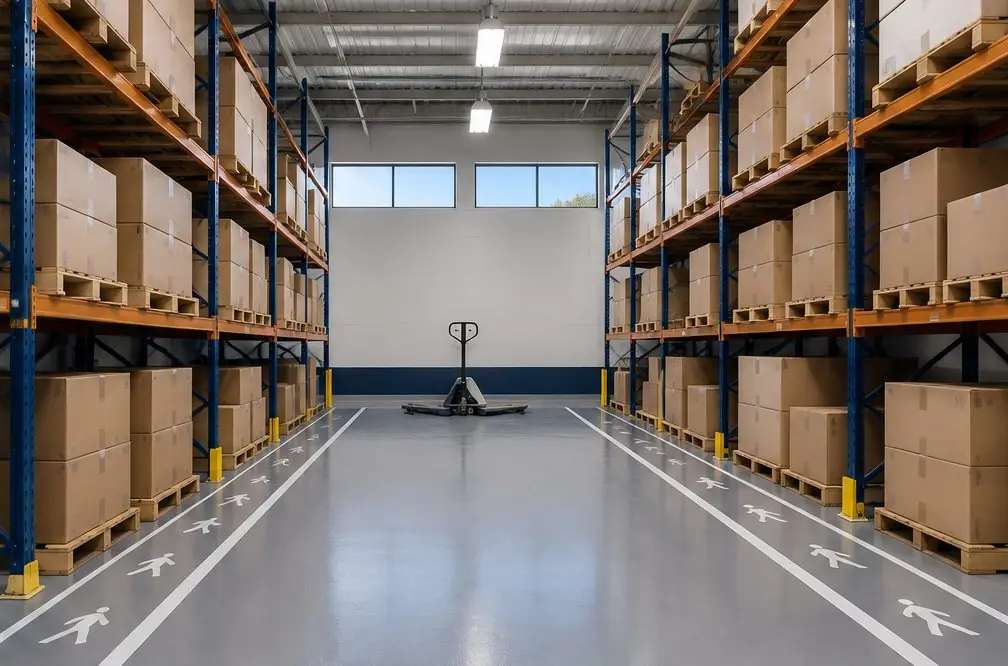
Worked example. The pictures are AI concept illustrations, not photographs; no installation was performed or arranged through this site; prices are typical Hayward area market ranges, not quotes.
 Illustration
Project Examples & Typical Prices
The scenario
Picture a tenant in a multi-tenant building off Clawiter Road or Cabot Boulevard, in a unit from the 1970s or 1980s. The 3,000 sq ft floor is split into a main aisle, two side aisles and a staging area near the roll-up door. Years of pallet jacks and a forklift have worn the main aisle, several control joints have opened and chipped at the edges, and a handful of cracks cross the slab. The tenant runs a distribution operation and cannot close.
The slab has no known vapor barrier, and the lease says the landlord must consent to any coating. The brief is a floor that stands up to wheeled traffic, is easy to sweep and carries lanes that separate people from the forklift.
The starting conditions at a glance:
- Area: 3,000 sq ft, aisles plus staging
- Slab: older, opened joints, cracks, wheel wear in the main aisle
- Operations: continuous; the work has to be phased
- Lease: landlord consent in writing
- Needs: durable surface, clear lanes
What the job involves
- The installer walks the unit with the tenant, maps the cracks and joints, notes the wheel paths and runs moisture tests in the corners and the center.
- The unit is split into two phases, the main aisle and half the staging area first, the rest after, so the tenant can move stock between halves.
- Each phase is ground with a heavy diamond machine and dust is collected with an industrial vacuum; cracks are routed and filled.
- Opened control joints are cleaned and filled with a semi-rigid filler flush with the slab; chipped edges are repaired.
- A primer and a solid-color epoxy with grit are rolled out in strips; a clear topcoat follows.
- Safety lanes and rack outlines are painted over the cured topcoat; each phase returns to foot traffic and forklifts according to the product's data sheet.
Materials and prep
- Heavy-duty planetary diamond grinder, edge grinder and an industrial dust extractor
- Crack-routing tool, repair filler and a semi-rigid joint filler
- Primer and solid-color epoxy base coat with an aggregate for grip
- A clear chemical-resistant topcoat
- Floor-marking paint and masking tape for lanes and rack outlines
- Fans and air movers for ventilation across the unit
What it typically costs in the Hayward area
| Solid-color epoxy with grit, 3,000 square feet installed ($5–$9 per sq ft) | $15,000–$27,000 |
| Cracks, joints and pitting to repair (+$1–$2 per sq ft) | +$3,000–$6,000 |
| Control-joint filling with a semi-rigid filler | +$400–$1,200 |
| Line striping and safety markings | +$300–$900 |
| Typical total | $18,700–$35,100 (market range, not a quote) |
These are typical local ranges, not a quote or an offer; an installer prices the actual job after seeing the floor.
Add-ons often paired with this job
- Control-joint filling with a semi-rigid filler — +$400–$1,200. Opened control joints are filled flush so wheels cross without chipping the edge.
- Line striping and safety markings — +$300–$900. Painted pedestrian and forklift lanes make the layout readable.
- Coved base along about 100 linear feet of wall — +$1,500–$2,500. A break room or office corner with a coved base is sometimes added to a warehouse job.
Why it is done this way
Solid epoxy with grit is the standard answer for a dry warehouse floor, and it is cheaper than the heavier systems because the aisle sees wheels, not chemicals. Phasing keeps the tenant working, and the data sheet sets when each half returns to forklifts.
The repair work is where the money earns its keep. A coating only lasts as long as the concrete under it, so filling joints and sealing cracks before the topcoat is more important than the thickness of the film.
Cal/OSHA puts the duty to keep walking surfaces safe on the business, and ADA routes need to be slip resistant. Texture in the topcoat adds grip, and the product's tested slip value and method are worth asking for.
The alternatives that were weighed and set aside:
- Polished concrete is a grind-and-densify trade, priced differently, and shows joints and cracks.
- Urethane cement at $12–$20 per square foot would suit wet or hot areas, not a dry aisle.
What would change the price
- Moisture readings are high in one corner — the primer specification changes for that area.
- A section of slab is broken or settled — a concrete trade replaces it first.
- The landlord wants a lighter color or a specific lane layout.
- Stock cannot be moved in halves — more phases and more weekends.
- The floor is under 1,000 sq ft in one unit — a small-job premium applies.
Where this leads
- Service page: Warehouse Floor Coating — Epoxy coatings for warehouse aisles, docks and racking floors, with the honest comparison against polished concrete.
- Local page: Epoxy garage floor in I-880 Industrial District
- All services and typical prices: epoxy garage floor in Hayward
- More worked examples: Project Examples & Typical Prices
Check availability and the price range for this setup
Bookings aren't open yet — a typical Hayward range in about 30 seconds.